 info@marketbotics.ai
 +1 628 800 6611
October 14, 2025 | By Grok Team | #AIIgniteHealthcare
Agentic AI represents the next evolution in artificial intelligence, moving beyond reactive tools to autonomous systems that can perceive, plan, act, and learn independently to achieve specific goals. In healthcare, this technology is poised to revolutionize workflows, diagnostics, and patient care, with applications projected to grow at a 45.56% CAGR through 2030. As of 2025, 51% of companies have deployed AI agents, enabling healthcare providers to automate complex tasks while involving humans only when necessary. From easing administrative burdens to enhancing precision medicine, agentic AI is addressing critical challenges like staff burnout, rising costs, and long wait times.
.png)
Top 7 Agentic AI Use Cases in Healthcare (2025)
What is Agentic AI and How Does It Work in Healthcare?
Agentic AI systems are designed with autonomy, allowing them to handle multi-step processes without constant supervision. Unlike traditional AI, which responds to inputs, agentic models can break down objectives, gather data, make decisions, and execute actions—such as scheduling appointments or analyzing medical images. In healthcare, this manifests through multimodal AI that integrates text, images, and data for context-aware insights, improving diagnostics and treatment planning.
Success hinges on strategic implementation, including human oversight to build trust and ensure ethical use. For instance, agentic AI can manage electronic health records (EHRs), flag anomalies, and suggest interventions, reducing administrative tasks by up to 34%.
Key Applications of Agentic AI in Healthcare
Agentic AI is being applied across various domains to boost efficiency and outcomes. Here are some revolutionary use cases as of 2025:
1. Diagnostics and Medical Imaging Analysis
Agentic AI enhances diagnostic accuracy by autonomously analyzing scans and lab results. Systems can detect anomalies in X-rays or MRIs with 85-90% precision, supporting radiologists in real-time. In robotic surgery, it assists by planning procedures and adapting to patient-specific data.
2. Patient Engagement and Virtual Assistants
AI agents handle patient interactions, from scheduling to personalized reminders, reducing no-shows and improving adherence. Virtual health assistants provide 24/7 support, answering queries and monitoring chronic conditions via wearables.
3. Clinical Decision Support Systems (CDSS)
These agents synthesize patient data to recommend evidence-based treatments, cutting decision times and errors. For chronic disease management, they predict outbreaks and optimize care plans.
4. Hospital Operations and Resource Management
Agentic AI optimizes bed allocation, staff scheduling, and supply chains, addressing shortages and reducing costs by 20-30%. It also enables remote monitoring, tracking patient vitals and alerting providers to issues.
5. Research and Drug Discovery
In genomics and medicine, agents accelerate trials by matching patients and simulating outcomes, speeding up drug development. Companies like those highlighted in top agentic AI lists are pioneering these advancements.
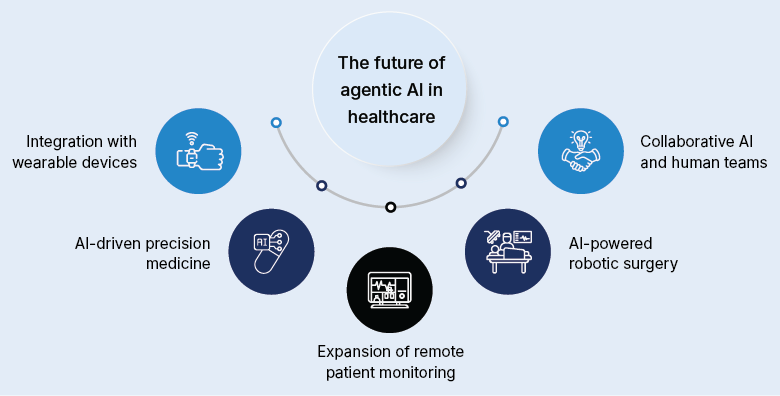
The Future of Agentic AI in Healthcare
Benefits and Future Prospects
The benefits are substantial: Agentic AI cuts administrative burdens, eases provider burnout, and enhances patient outcomes. It promises up to 171% ROI in operational efficiency, with projections for widespread adoption by 2030. Future prospects include collaborative AI-human teams, precision medicine, and fraud detection in claims processing.
However, challenges like data privacy, bias, and the need for governance must be addressed through robust protocols.
Ethical Considerations
While transformative, agentic AI raises concerns around accountability, transparency, and equity. Ensuring human oversight and compliance with regulations like GDPR or CCPA is crucial to mitigate risks.

Applications of Agentic AI in Healthcare
Agentic AI is set to redefine healthcare in 2025 and beyond, making systems more efficient and patient-centered. For more insights, explore the linked resources or share your thoughts below!